
Flame Retardant vs Fire Resistant Cable: Standards, Testing & Selection Guide
Standards, testing methods, and specification decisions that separate flame retardant from fire resistant cables — with an East China metro selection case.
Flame retardant vs fire resistant cable — IEC 60332 vs IEC 60331 standards, BS 6387 testing methodology, and how EPC engineers spec WDZ-YJY versus WDZN-YJY for tunnels, hospitals, and high-rises. Eight-scenario selection matrix plus an East China metro case.
Why the Flame Retardant vs Fire Resistant Distinction Matters
For engineers speccing cable in tunnels, high-rises, hospitals, and industrial plants, "flame retardant" and "fire resistant" often get used interchangeably in RFQs and sometimes in supplier catalogs. They are not synonymous. They describe two different fire-safety behaviors, tested to different standards, and priced at meaningfully different points.
Getting this wrong carries real consequences. A cable specified as flame retardant slows the spread of flames along a cable route — but the cable itself will still fail as a working conductor within minutes of sustained fire exposure. A fire resistant cable maintains circuit integrity for a defined duration (typically 90 minutes to 3 hours) at temperatures up to 950°C. In an office corridor both may be acceptable. In a metro tunnel emergency evacuation lighting loop, only fire resistant meets code — and misspeccing can result in the project failing final inspection, insurance coverage denial, or fatal delays in a real fire event.
This guide walks through what each grade actually does, the standards behind them (IEC 60332 vs IEC 60331, BS 6387, GB/T 19216), an eight-scenario application matrix, and the verification checks EPC engineers and procurement teams use to confirm they are receiving what they ordered.
What Flame Retardant Cable Actually Does
A flame retardant cable is designed to prevent flame propagation along the cable route. When a fire ignites at one end of a cable bundle, the flame retardant construction ensures the flame does not travel down the cable itself and ignite additional cables further along the trench, tray, or tunnel wall.
The mechanism sits in the jacket and insulation compounds. Fire retardant additives — typically magnesium hydroxide Mg(OH)₂ or aluminum hydroxide Al(OH)₃ — release water vapor endothermically when heated above 200°C. That release cools the surrounding air and dilutes combustible gases, starving the flame front.
Key point: the cable itself will still eventually fail. Once temperatures sustain above 400°C, the copper conductor loses tensile strength and insulation carbonizes. Circuit integrity is not maintained — the design goal is only to stop flame spread to adjacent infrastructure.
Standard tests for flame retardant construction:
- IEC 60332-1-2 — single-cable vertical flame test (500 W burner, 60-second ignition, cable must not burn beyond 425 mm above the burner).
- IEC 60332-3-24 Category C — bundled cable in vertical tray (7 cables, 40 minutes flame exposure, damage height under 2.5 m).
- GB/T 18380 — Chinese national standard, equivalent to IEC 60332 series with A/B/C bundling categories.
Common Chinese designations: ZR- prefix (阻燃) for flame retardant with PVC-based jacket; WDZ- prefix (无卤低烟阻燃) for halogen-free, low-smoke, flame-retardant construction. Our WDZ-YJY 0.6/1kV LSZH flame-retardant power cable is the WDZ variant most commonly speced for general building and infrastructure circuits.
What Fire Resistant Cable Actually Does
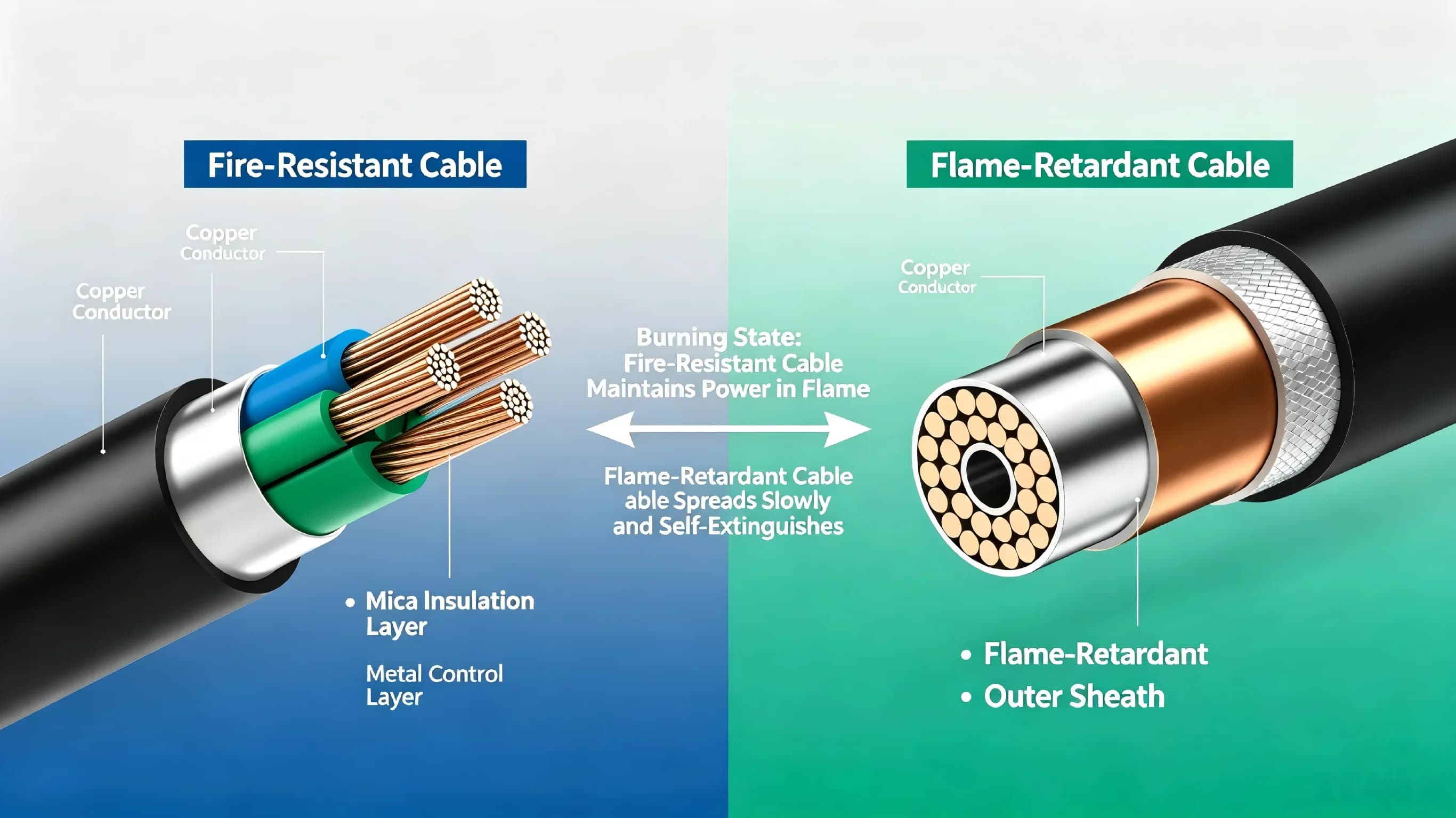
A fire resistant cable maintains its ability to carry current — specifically, to keep an emergency circuit alive — for a defined time period during direct fire exposure at high temperature.
The mechanism is structural. Between the copper conductor and the outer insulation, fire resistant construction adds one or more layers of mica tape (synthetic phlogopite mica bonded onto a glass fiber substrate). Mica remains dimensionally stable and electrically insulating even at 1000°C — long after conventional PVC or XLPE insulation has carbonized and lost integrity.
The performance thresholds are severe. A cable rated to BS 6387 Category CWZ must survive 950°C flame contact for 3 hours, followed by water spray simulating fire hoses, followed by mechanical shock — all while maintaining circuit continuity. Cables that qualify are what get specified for fire pump feeders, emergency stairwell lighting, and metro tunnel ventilation control.
Standard tests for fire resistant construction:
- IEC 60331-11 — 750°C flame for 90 minutes on a single cable, circuit must remain intact throughout.
- IEC 60331-21 — system-level test at 750°C for 90 minutes (cable plus terminations).
- BS 6387 — the highest-severity global standard. Category A (650°C), B (750°C), C (950°C), plus W (water spray) and Z (mechanical shock). "CWZ" combines all three.
- GB/T 19216 — Chinese national standard defining Class NH-A/B/C corresponding to test severity.
Common Chinese designations: NH- prefix (耐火) for fire resistant, WDZN- prefix (无卤低烟耐火) for halogen-free low-smoke fire-resistant. Our WDZN-YJY 0.6/1kV LSZH fire-resistant power cable is the WDZN variant speced for emergency and life-safety circuits.
Four Core Differences (Side-by-Side)
Rather than a wall of text, four dimensions capture how these grades diverge:
- Test temperature and duration. Flame retardant tests apply 400–500°C for 60 seconds to 40 minutes. Fire resistant tests apply 750–950°C for 90 minutes to 3 hours. Different orders of magnitude on both axes.
- What survives. A flame retardant cable's success criterion is that adjacent cables and infrastructure do not ignite. The cable itself may be destroyed. A fire resistant cable's success criterion is that its own circuit stays energized — the cable must keep working under fire.
- Structural difference. Flame retardant construction uses additive-loaded jacket and insulation compounds (Mg(OH)₂ or Al(OH)₃). Fire resistant construction adds a mica tape wrap around each conductor before extrusion of the primary insulation — that mica layer is what preserves circuit integrity.
- Cost premium. In practical procurement, fire resistant runs 40–60% higher unit cost than equivalently sized flame retardant. That premium is why mixed-grade specifications (flame retardant for general circuits, fire resistant for emergency circuits only) are common on real projects — you do not overspec everywhere.
Standards Deep-Dive: IEC / BS / GB Cross-Reference
Procurement documentation across Southeast Asia, Europe, and China draws from three main standards families. Understanding how they map matters when reviewing certificates from Chinese manufacturers exporting to SEA — where BS-derived local standards (SIRIM in Malaysia) coexist with IEC-adopted local standards (SNI in Indonesia).
Flame retardant test methods (equivalence table):
- IEC 60332-1-2 ↔ BS EN 60332-1-2 ↔ GB/T 18380.11 — single cable, vertical.
- IEC 60332-3-22 (Category A) — 7.0 L/m non-metallic material bundled, most stringent.
- IEC 60332-3-24 (Category C) — 1.5 L/m non-metallic material, common commercial spec.
- IEC 60332-3-25 (Category D) — 0.5 L/m, lightest bundling requirement.
Fire resistant test methods:
- IEC 60331-11 — system test at 750°C, 90 minutes.
- IEC 60331-21 — rigid cable system with terminations.
- IEC 60331-31 — impact plus water spray extension.
- BS 6387 — higher severity than IEC 60331. C = 950°C for 3 h; W = water spray for 15 min at 650°C; Z = mechanical shock every 30 s. "CWZ" is the ceiling.
- BS 8434-2 — 120 minutes at 950°C with water and shock, for critical building services.
- GB/T 19216.11 — Chinese equivalent to IEC 60331 series.
Bottom line: when a data sheet cites IEC 60332-3-24 it is a flame retardant claim; when it cites IEC 60331-11 or BS 6387 it is a fire resistant claim. They are not interchangeable, and the same cable rarely qualifies for both without deliberate dual-rated construction (typical WDZAN variants).
Eight-Scenario Application Selection Matrix
Real projects need mixed specifications. Here is how eight common scenarios typically resolve:
- Office building general lighting and power. Flame retardant is sufficient. ZR-YJV for PVC or WDZ-YJY for LSZH tenants.
- Office building emergency lighting and evacuation signage. Fire resistant required. WDZN-YJY covers most jurisdictional codes.
- Hospital ICU, surgical wards, and life-safety equipment. Fire resistant, mandatorily. WDZN-YJY at minimum; some jurisdictions require BS 6387 CWZ-grade.
- Metro / rail tunnel — signaling, emergency ventilation, evacuation lighting. Fire resistant. WDZN-YJY or NH-YJV. General tunnel lighting can remain flame retardant only.
- Petrochemical plant cable trench. Flame retardant for general instrumentation. Fire resistant for shutdown valves, fire pump feeders, and emergency depressurization circuits.
- Data center. Flame retardant baseline (WDZ-YJY) for main feeders and PDU-to-rack. Fire alarm control circuits, UPS bypass, and battery backup feeders require fire resistant.
- Shopping mall or airport terminal. Flame retardant for general power. Emergency stairwell lighting and smoke evacuation fans require fire resistant.
- High-rise residential (100 m+). Fire resistant on standpipe pump feeders, emergency lift, and pressurization fan circuits. Flame retardant on general branch circuits.
The right answer for most projects is a mixed BOQ where 15–25% of cable length is fire resistant (emergency circuits) and 75–85% is flame retardant (general power). Speccing 100% fire resistant is over-engineering that inflates project cost by 30%+ without additional safety benefit. Speccing 100% flame retardant leaves emergency circuits non-compliant.
China Rail Transit Case: Why Selection Actually Matters
An East China metro line that Hongce Cable supplied illustrates how the flame / fire distinction resolves on a real project.
The tender specified a mixed cable BOQ. Regular tunnel lighting, station platform power, and general control circuits were speced as WDZ-YJY 0.6/1kV (flame retardant, LSZH). Emergency evacuation lighting, tunnel ventilation control, fire alarm loops, and signaling communications were speced as WDZN-YJY 0.6/1kV (fire resistant, LSZH).
The distinction was not marketing preference — it reflected China's GB 50490 metro fire-safety code, which requires critical circuits keep working long enough for passengers to evacuate the tunnel and for the ventilation system to purge smoke. Ninety minutes at 750°C — the IEC 60331-11 threshold — corresponds roughly to the maximum evacuation window for a fully loaded rush-hour train stranded in tunnel.
Practical outcome: WDZN-YJY made up about 22% of total cable length but 34% of cable spend. That premium was fully allocated to the specific circuits that needed it, with the other 78% of length using the cheaper flame retardant grade. Speccing everything as fire resistant would have inflated the cable BOQ by roughly 30% with no additional safety improvement on the general-purpose circuits.
The procurement takeaway: a supplier should be able to ship both grades with matching certifications from the same production batch traceability. Suppliers that only do one grade well are a red flag on projects that need both.
How to Verify You Are Getting What You Ordered
Cable jacket printing and certificate covers cost pennies to fake. Real verification lives in the details.
- Test report by specific standard, not just "certified". Require the actual test report showing an IEC 60332-1-2 or IEC 60331-11 pass — not a generic "flame retardant certification" claim. The report should reference the specific production batch or manufacturing series, not a decade-old sample submission.
- Mica tape check (destructive sample). For any cable sold as fire resistant, cut a 30 cm sample, strip the outer jacket, and remove the primary insulation. A properly constructed fire resistant cable has a visible mica tape wrap (silvery-grey, glass-fiber backing) directly around the copper conductor. No mica = not fire resistant, regardless of what the certificate cover says.
- Halogen content for LSZH variants. A WDZ or WDZN designation requires halogen content under 0.5% and smoke density per IEC 61034. Request the specific test data sheet showing measured HCl gas emission from the polymer compound.
- Certificate registry verification. Chinese test reports issued by CQC (China Quality Certification Center) can be verified at their online registry using the certificate number. Reports from SGS / TÜV / Intertek similarly cross-reference on the issuing lab's public database. If a certificate does not resolve online, it is likely counterfeit.
- Copper purity as prerequisite. Both flame retardant and fire resistant grades depend on the underlying copper conductor being genuine. Under-purity copper affects both current-carrying capacity and long-term behavior under thermal stress. Our 99.95% oxygen-free copper verification guide covers the DC resistance and OES verification methodology applicable to any cable grade.
For control cable variants, similar substitution risk exists — pure copper versus copper-clad aluminum. Our CAT6 UTP CCA substitution checks walks through six verification methods for network cable specifically, and the methodology applies to any twisted-pair control cable claimed as pure copper.
Get the Spec Right: Product Choices for Your Next BOQ
Getting the flame retardant vs fire resistant distinction right saves cost, satisfies code, and prevents worst-case fire scenarios. Getting it wrong is a compliance failure that can cost 30x more to remediate mid-project than to design correctly up front.
For LSZH flame retardant construction on general circuits, see WDZ-YJY 0.6/1kV LSZH Flame-Retardant Power Cable. For LSZH fire resistant on emergency and life-safety circuits, see WDZN-YJY 0.6/1kV LSZH Fire-Resistant Power Cable. For projects that require both — the typical metro, hospital, or high-rise BOQ — Hongce Cable ships both grades from the same batch traceability system with matching certifications and delivery windows.
For projects in Southeast Asia carrying additional environmental exposures (termite, water ingress, tropical UV), see our anti-termite and waterproof cable sheathing guide for the jacket-material overlay on top of the flame / fire grade decision.
About the Author
Junjie Cheng – Senior Cable Engineer at Hongce Cable Junjie Cheng is the Senior Cable Engineer at Zhejiang Hongce Cable Co., Ltd., specializing in power cable design, manufacturing processes, and international quality control. He leads Hongce Cable’s technical team to deliver customized cabling solutions for global infrastructure and power grids. Mr. Cheng specializes in the engineering of medium-to-high voltage cables. He recently spearheaded the successful technical review and production of a RMB 5.5 million (approx. USD 760K) export project to Malaysia, delivering high-performance YJLV 6/10KV 3*150 mm² XLPE insulated aluminum power cables. His deep expertise in triple-layer co-extrusion and drum twister cabling guaranteed the strict mechanical and electrical performance required for Malaysia's power environment. Under his technical guidance, Hongce Cable ensures all products comply with IEC, BS, ASTM, and CE certifications, providing safe, efficient, and certified power transmission solutions to global B2B buyers.