The Ultimate Guide to Control Cables: Applications, Specs, and Troubleshooting
GB/T 9330 control cables explained — core applications, how they differ from power cables, and a professional troubleshooting workflow.
If power cables are the arteries of an electrical system, control cables are its nervous system. This guide covers GB/T 9330 control cable applications, the key differences from power cables, and a step-by-step troubleshooting workflow.
In the vast and complex networks of power systems and industrial automation, if power cables are the "arteries" transporting energy, then control cables are the "nervous system" transmitting critical commands.
Manufactured according to the national standard GB/T 9330, control cables are specifically designed for control and protection circuits with an AC rated voltage of 450/750V and below. In this guide we break down their core applications, key specifications, and how to handle common faults.
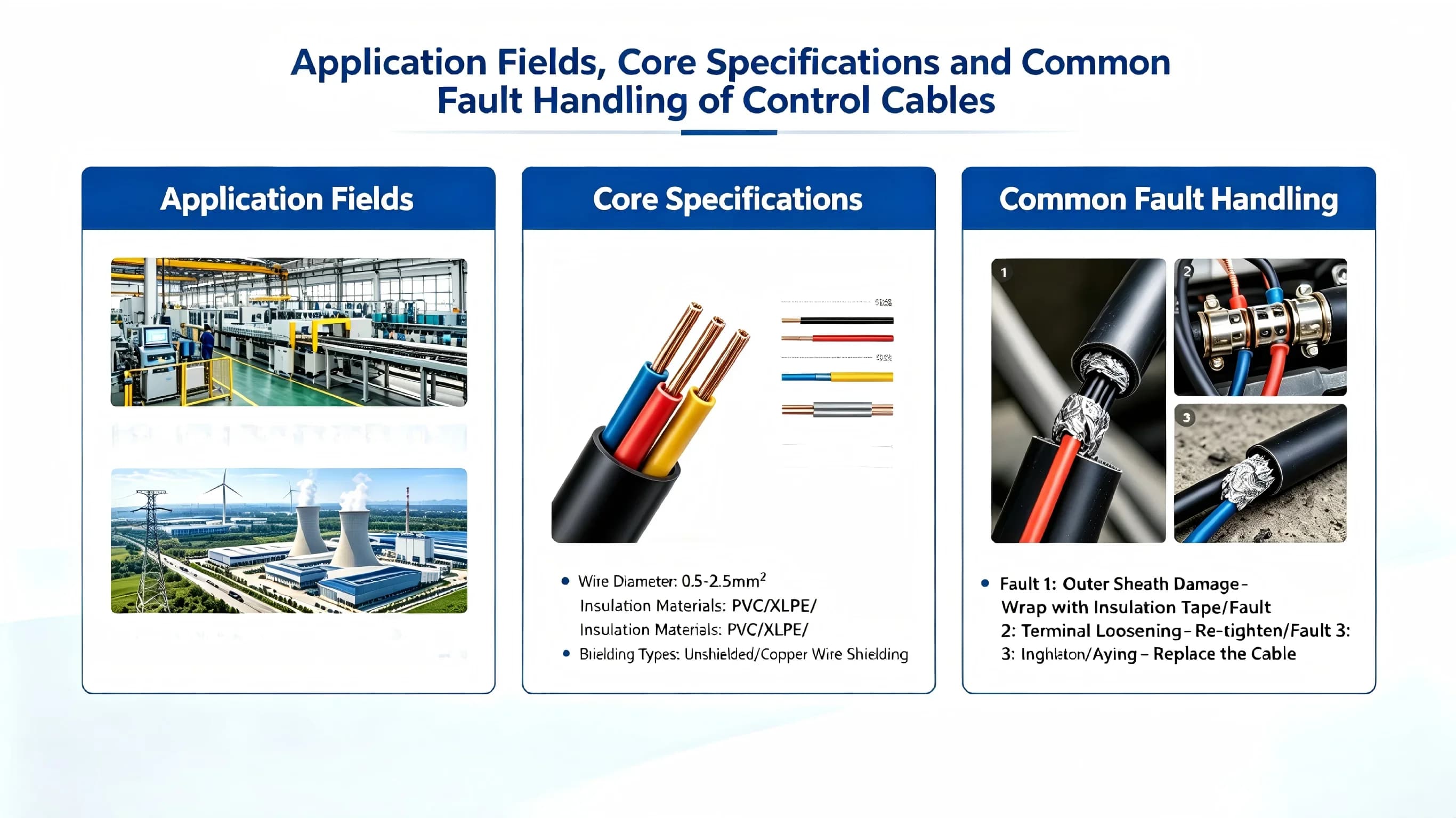
Core Application Areas of Control Cables
Control cables are widely used in environments demanding precise signal transmission and continuous system monitoring:
Industrial & Mining Enterprises — control and protection circuits for automated production lines, ensuring commands are executed flawlessly.
Energy Sector — the backbone of remote monitoring and secondary circuits in power plants and substations.
Transportation — signal transmission in urban rail transit, traffic light control, and shipbuilding systems.
Petrochemical Industry — safe, reliable instrument connections and data acquisition in explosion-proof environments.
Control Cables vs. Power Cables: Core Differences
Many buyers confuse control cables with power cables. Here is a detailed breakdown of the core technical differences:

Electrical Performance and Technical Advantages
High Dielectric Strength — Control cables have excellent insulation properties, withstanding high voltages between conductors and between conductors and the shielding layer, ensuring no electrical breakdown during operation.
Superior Anti-Interference — Polyethylene insulation and PVC sheathing, combined with metal shielding (copper tape or braided shielding), effectively prevent electromagnetic interference (EMI) from affecting signal integrity.
Customized Manufacturing — Production is highly customizable to user requirements, with variations in core counts, cross-sectional areas, and special properties such as flame-retardant, fire-resistant, and LSZH (Low Smoke Zero Halogen).
Common Fault Analysis & Troubleshooting Guide
During long-term, high-load operation, cables may develop issues. Common fault modes include external mechanical damage, moisture ingress from poorly sealed terminal joints, and insulation degradation caused by long-term overloading or high-temperature environments.
Standard troubleshooting steps:
- 1. Disconnect power immediately — safely cutting off power is the first priority to prevent secondary damage.
- 2. Locate the fault — use professional cable fault testers to pinpoint the exact location.
- 3. Analyze the root cause — determine whether the fault is human-induced mechanical damage, environmental corrosion, or natural aging.
- 4. Repair and retest — cut out the damaged section and splice the connections. Before restoring power, withstand voltage and insulation resistance tests are mandatory.
Industry Outlook: The Rise of Chinese Cable Manufacturing
Wire and cable manufacturing has grown to become China's second-largest economic sector. Domestic market satisfaction and market share have exceeded 90%, and China's total cable output value now ranks first globally. With the continuous expansion of data communications, rail transit, and new energy industries, global demand for high-quality, high-performance control cables manufactured in China is expected to maintain robust growth.
Looking to source premium control cables for your automation or infrastructure projects? Contact our cable engineers today to request detailed product catalogs and competitive factory-direct pricing.
About the Author
Junjie Cheng – Senior Cable Engineer at Hongce Cable Junjie Cheng is the Senior Cable Engineer at Zhejiang Hongce Cable Co., Ltd., specializing in power cable design, manufacturing processes, and international quality control. He leads Hongce Cable’s technical team to deliver customized cabling solutions for global infrastructure and power grids. Mr. Cheng specializes in the engineering of medium-to-high voltage cables. He recently spearheaded the successful technical review and production of a RMB 5.5 million (approx. USD 760K) export project to Malaysia, delivering high-performance YJLV 6/10KV 3*150 mm² XLPE insulated aluminum power cables. His deep expertise in triple-layer co-extrusion and drum twister cabling guaranteed the strict mechanical and electrical performance required for Malaysia's power environment. Under his technical guidance, Hongce Cable ensures all products comply with IEC, BS, ASTM, and CE certifications, providing safe, efficient, and certified power transmission solutions to global B2B buyers.